Wednesday, December 12, 2012

Archeology Dog


             Through out the centuries humans have relied on dogs to become what we lack. We have relied on them to become the eyes for the blind and the noses that find drugs and bombs for  the police force. These few examples do not even scratch the surface to what dogs can truly accomplish when  trained correctly. Their noses are genetically equipped with some 200 million more olfactory receptors than human's, and researchers now, not only, have begun to use dogs to assist them in tracking and monitoring populations of wild species but also guide archaeologists to old bones and grave sites.
            Gary Jackson, an australian dog trainer, has trained a black lab mix named Migaloo to sniff out old human bones by enticing her with a ball. He found that the best way to condition Migaloo and reward her for her find was by using a ball that she so desperately wants. There have been dogs that have been used to sniff out old human remains, but the factors of other decomposed odors in an area often confuse the dogs because the smells are very similar. But by training a dog to know just the smell of human bones, removes those factors, making the finds more accurate. Migaloo has been able to find bones from 300 meters away even if it is as small as a fingernail, sometimes they would even just take the scent from a bone with a cotton ball and touch it to a rock ad she would be able to find it. The biggest test they ever did with Migaloo was have her search for an old aboriginal grave that was 600 years old and she was spot on. 
           This research will allow old cold cases to be reopen, families will be able to find and bury their loved ones that they lost, and archeologists will be able to make new discoveries all because of a dogs nose. Gary Jackson is even looking to train Migaloo to find pottery, old fossils and maybe even dinosaur bones, and he is planning on taking Migaloo to France and Belgium to try to discover old remains from battlefields in World War II. In my opinion, the use of dogs in areas that are beyond our human abilities is astounding and to be able to train a dog to accomplish such a task opens doors into research and findings that would be impossible with out "mans best friend."

Sunday, December 2, 2012

Membranes


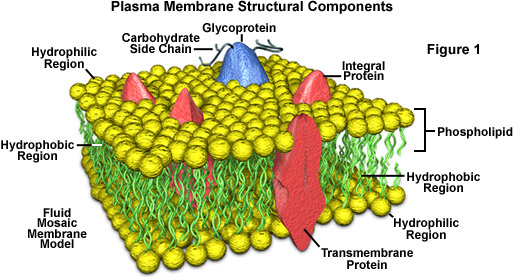
The definition of a membrane is a thin, film-like structure that acts as a selective barrier or a separating structure that allows only certain particles or chemicals to pass through. A cell has an outer plasma membrane and an internal plasma membrane. The outer plasma membrane forms a barrier between the cell and its surroundings, controlling the traffic of molecules in and out of the cell, exhibiting the characteristics of a selective permeable membrane. The internal plasma membrane provides a structural order for the metabolism. A membrane’s structure is like a complex fluid mosaic. It is made up of proteins and molecules that are embedded in a phospholipid bilayer. The phospholipids are the main structural component of the membrane, the organization of the phospholipid bilayer allows the hydrophobic tails to be protected by the hydrophilic heads, due to the polarization of the heads and the non-polarity of the tails.
The proteins that are embedded in the membrane are either integral proteins or peripheral proteins. Integral proteins span the entire membrane but peripheral proteins are either on one side of the membrane or the other.
Though the structure of the membrane is made of phospholipids, most of the membranes functions are accomplished by the embedded proteins. There are many kinds of proteins and each have a specific function. There are cell-cell recognition  proteins that identify the type of cell and indicate what is the cell’s and what is “foreign.” Most of the cell-cell recognition proteins are  glycoproteins, which are short chain carbohydrates that attach onto the extracellular side of the membrane, all carbohydrate chains are very specific and vary between species, individuals and cell types, which is why they are used by the cell to make sure that nothing foreign enters that specific cell. Another type of protein that is embedded in the membrane are integrins. Integrins are the main integral protein that strengthens and provides structure to the membrane. There are also intercellular junction proteins, that help corresponding cells stick together to form tissues; enzymes, which activate the biochemical reactions that occur in the cells; and receptor proteins, which bind hormones and other substances to the outside of the cell allowing a change inside the cell to be triggered. The other protein that should be mentioned are the transport proteins, which have two different forms. There are passive transport proteins which do not require energy and allow soluble substances to pass through the membrane and there are active transport proteins that allows the cell to expend energy in order to transport water soluble substances against their concentration gradient.